Showing posts with label Film openings. Show all posts
Showing posts with label Film openings. Show all posts
Monday, 9 May 2016
Target audience feed back

Wednesday, 10 February 2016
Audience feedback - Rough cut 3
Friday, 22 January 2016
Audience feedback - Rough cut 1
Wednesday, 21 October 2015
Film opening times
Film Openings: List of films being covered
...
TOM CROSS - Bridget Jones' Diary (WT rom-com)
LENGTH OF OPENING: 7:00
IDENTS COMBINED LENGTH/TIME OF SHOT 1: 1:00
SHOT 1 + ANALYSIS:
LOUIS - The Boat That Rocked (WT rom-com)
LENGTH OF OPENING: 3:15
IDENTS COMBINED LENGTH/TIME OF SHOT 1: 0:41
SHOT 1 + ANALYSIS:
MILO - Atonement (WT war drama/romance)
LENGTH OF OPENING: 1:44
IDENTS COMBINED LENGTH/TIME OF SHOT 1: 0:30 (idents) 1st shot 0:52
SHOT 1 + ANALYSIS:
ROBBIE - Napoleon Dynamite (Indie teen comedy)
LENGTH OF OPENING: 5:19
IDENTS COMBINED LENGTH/TIME OF SHOT 1: 0:56
SHOT 1 + ANALYSIS:
ALEX - Burn After Reading (WT, Coens arthouse)
LENGTH OF OPENING: 6:22
IDENTS COMBINED LENGTH/TIME OF SHOT 1: 1:22
SHOT 1 + ANALYSIS:
NIAMH - Ferris Bueller's day Off (80s teen comedy)
LENGTH OF OPENING: 3:17
IDENTS COMBINED LENGTH/TIME OF SHOT 1: 0:14 (1 ident), 0:35 to shot1
SHOT 1 + ANALYSIS:
RIAN - Wish You Were Here (WT's 2nd film, drama, some comedy/social realism)
LENGTH OF OPENING: 1:28
IDENTS COMBINED LENGTH/TIME OF SHOT 1: [none]
SHOT 1 + ANALYSIS:
NICOLA - Four Lions (Warp, social realist comedy)
LENGTH OF OPENING: 3:20
IDENTS COMBINED LENGTH/TIME OF SHOT 1: 0:20 (1st title appears later, 3:11 in)
SHOT 1 + ANALYSIS:
CHARLES - Le Donk and Scor-Zay-Zee (Warp, £48k mockumentary)
LENGTH OF OPENING: 2:30
IDENTS COMBINED LENGTH/TIME OF SHOT 1: none;
SHOT 1 + ANALYSIS:
WILL - About a Boy (WT rom-com)
LENGTH OF OPENING: 5:41
IDENTS COMBINED LENGTH/TIME OF SHOT 1: 0:40 (0:53 to shot1, a tracking shot)
SHOT 1 + ANALYSIS:
TOM ATKINSON - Ali G Indahouse (WT2 comedy)
LENGTH OF OPENING: 3:10
IDENTS COMBINED LENGTH/TIME OF SHOT 1: 0:45 (1:20)
SHOT 1 + ANALYSIS:
Thursday, 15 October 2015
The Guvnors Opening Analysis
Writer: Gabe Turner
Director: Gabe Turner
Starring: Mark Preston, Richard Blackwood, Joelle Koissi
Storyline
The Guvnors is both love letter and hate mail to the alpha male. This story's alpha is Mitch who lives buried in suburban London, having turned his back on his previous life of casual violence and intimidation as part of a legendary South East London firm. In the modern day he's the doyen of respectability and quiet confidence, but Mitch used to be a Guv'nor. This film holds a mirror up to Mitch and shows him the monster once again, buried deep in both DNA and psyche, desperate to break out and wreak havoc. ( http://www.imdb.com/title/tt2992524/?ref_=ttpl_pl_tt )
Analysis
Analysis
There are 2 company idents: Fullwell73 Productions and Metrodome Distribution. There are 20 titles all together including the main title of the film, these titles are white in a san serif font. As the title appears it is in a different place on the screen each time- this could have been done to avoid dullness. When the title dissapears the letters go one by one. They dissapear with smoke almost like an explosion, this could possibly have connotations with guns as they are involved in the film. For the main title it is red on a black backround which could symbolise violence. It is in a simplistic bubble font with black marks on it as if the title has worn away- this signifies decay and working class. From the start to the main transitioning to the film the duration is 3 minutes 45 seconds.
The first shot is a medium two shot. One character is stood up smoking and the other on is sat on the sofa. At this point in terms of sound/music there is like a whistling backround noise which is a bit misterious which creates suspence. On top of this there is diologue between the two chatacters. After this scene it proceeded to a montage where the clips alternate between the older man living in a middle class lifestyle to earlier footage of his working class upbringing.
Source:Louis@JayRProductions
Source:Louis@JayRProductions
Monday, 12 October 2015
Pretty in pink opening analysis
Pretty and pink title list:
- Paramount pictures presents
- A John Hughes production
- Pretty in pink
- Starring Molly Ringwald
- Harry Dean Stanton
- Jon Cryer
- Annie Potts
- James Spader
- and Andrew McCarthy
- Co-Starring Jim Haynie
- Alexa Kenin
- Kate vernon
- Music score composed by Michael Gore
- Casting by Paula Herold
- And Marci Liroff
- Costume designer Marilyn Vance
- Edited by Richard Marks
- Production designer John W. Corso
- Director of photography Tak Fujmoto
- Executive producers John Hughes
- and Michael Chinich
- Written by John Hughes
- Produced by Lauren Shule

Semiotic film analysis
The opening shot in this is a tracking shot which follows the movement of a truck. The setting is situated in a rundown area. From what can be connoted from the first shot, you see the road is broken up and blatantly hasn't been maintained also the grass is growing everywhere. This can be denoted to signify the fact that this specific residential area is not looked after and is possibly poverty ridden.
Thursday, 8 October 2015
Ali G indahouse film opening analysis
Ali G Indahouse
(Mark Mylod, 2002)Produced by Working Title (+2); distribution: Universal
Budget:£5m


This shot appears after a brief confrontation between two women and a thug looking man. The camera is static but the car moving towards the camera as if making an entrance.
We can denote from this screenshot that the area is touch looking a rather dirty. This connotes where the film is set in and the area set it. this may lead onto what genre the film may be. The viewer is yet to see the central protagonist which is a sign of narrative enigma. The bright yellow car can be denoted, this may connote what kind of person the central protagonist is and also suggests there may be humour involved in the genre.
The opening montage to this is followed by a very exaggerated shoot out scene which is made comically to make the audience laugh. So straight away the genre of the film is revealed. This shoot out is also a dream, so after this opening shoot out 'Ali G' wakes up, snapping back into reality.
During the opening montage of the film, we see no character apart from extras used to create a sense of where the film is set. As the opening the montage finishes, we see actors which aren't included in the film, just the opening for a short period. We then see the main protagonist (Ali G) who enters humorously. Straight away we get a sense of the character personality.
Duration of opening = 3:10
Source:http://atkostudios.blogspot.co.uk/
The Boat That Rocked Opening Analysis
The Boat That Rocked
(Richard Curtis, 2007)
Produced by Working Title (+2); distribution: Universal
Budget:$50m
Box Office: $36,348,748 m (world)
Summary: In 1966, BBC radio broadcasts less than an hour of pop music a day, forcing pirate DJs to take up the slack from boats anchored outside British waters. Quentin (Bill Nighy) is the commander of such a pirate station, overseeing a host of seedy, lusty and dope-smoking DJs, including the Count (Philip Seymour Hoffman) and Dave (Nick Frost), who makes it his personal mission to see to it that Quentin's newly arrived godson (Tom Sturridge) loses his virginity.
Idents
There are 2 company indents:
- Universal (20 seconds)
-Working Title (10 seconds)
1st shot
The first shot is an extreme long shot and also an establishing shot
Titles
The first shot is an extreme long shot and also an establishing shot
Titles
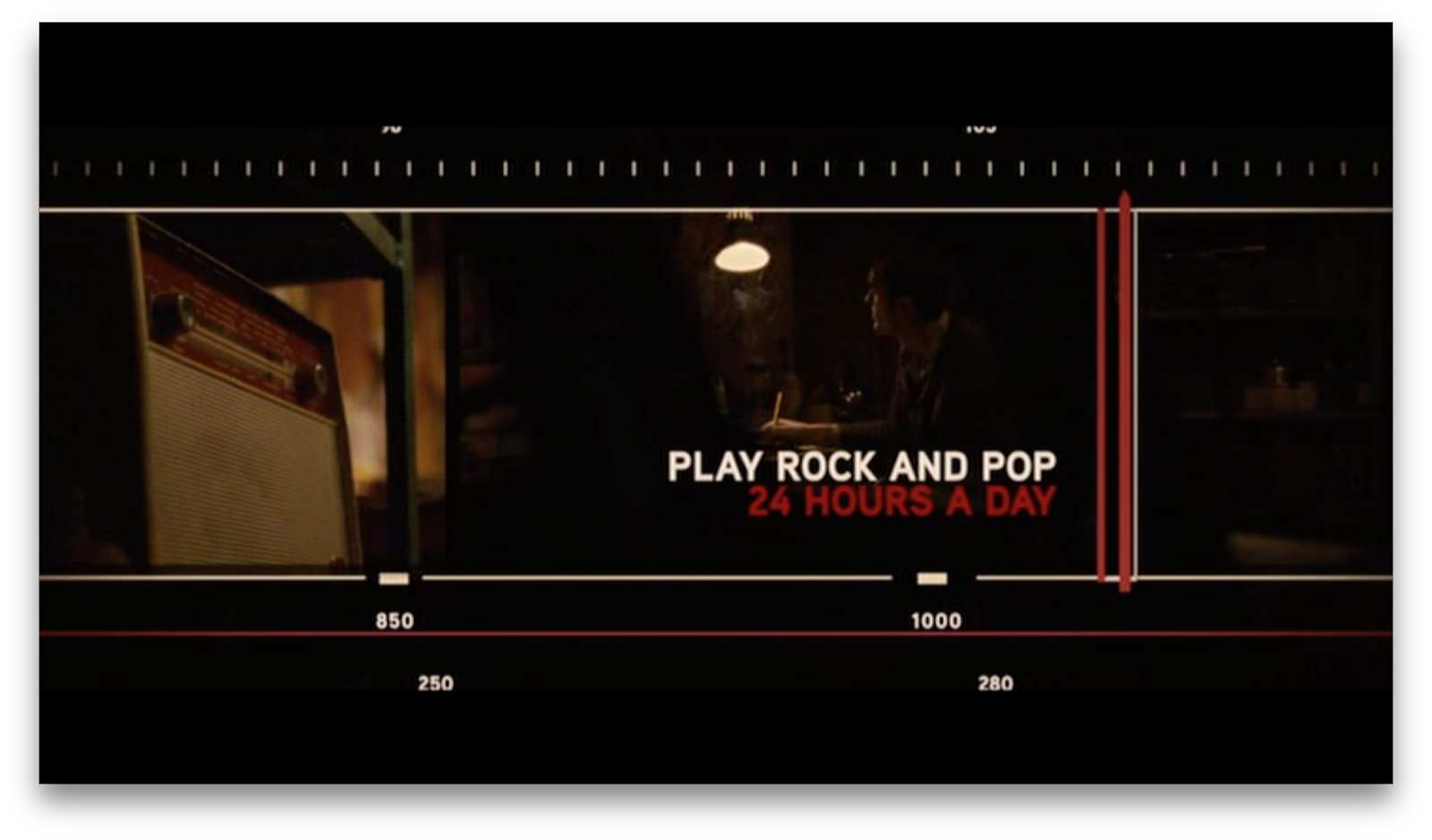
There are 14 titles although some of these titles are ones that tell a story. The animated graphic on screen is tuning a radio representing radio dial and the titles are in a strip going across the screen. Each title is positioned differently- this is to avoid dullness. Also the titles have more that one colour, white and red. Each title is transitioned with a wipe edit. This was to create verisimilitude as the film was set in 1966 and now to see a wipe edit being used. In the title "The Boat That Rocked" the words "boat" and "rocked" we're in upper case whereas the words "the" and "that's" we're in lower case and half the size.
Duration
The opening sequence is 00:03:15
Sound, Music
The opening sequence is 00:03:15
Sound, Music
On the working title company ident there is an audio bridge starts. The sound is diegetic because the it is coming out a radio. The music ends when the last title comes on before the 1st shot.
Shot Variety
At the start the shots are fairly short. A shot reverse shot, shot revesrse shot them a cut away show has been used.
Intertextuality + Genre Signifiers
Narrative + Exposition
Mise-en-scene: Props, Location, Lighting
The mise-en-scene is a montage with lots of different clips. It is switching between the radio station on the boat and lots of locations around Britain of people listening to the radio live.


The key props that can be spotted is the microphone in the radio station and the radios that the people around Britain are listening to.
Transitioning to the main film
The opening of the film is separated from the main body of the film by the title which is conventional. The edited footage in the opening links to the audio nicely as he is waving his arms to the sound of the music.




Four Lions Opening Analysis
(Chris Morris, 2010)
Produced by Warp Films, (+ Film4; Wild Bunch, Optimum Releasing)
Budget: £2.5 million
 |
| The film opens with the company ident for Wild Bunch (10 seconds in length.) As "Wild Bunch" is a German Film Distribution Company, we understand this company ident to mean that they were the distributors for "Four Lions" |
 |
| "Film4" is a production company, so this company ident (10 seconds in length) reveals to us that they produced "Four Lions". Both company idents keep their original sound. |
 |
| This is the first shot of the film. There are no titles - it simply cuts in with a static medium-long shot (that shifts ever so slightly) of one of the characters in the middle third. All the sound is diegetic. It can be denoted that the character looks middle-eastern, is wearing dark, khaki clothing, and a head band with what appears to be islamic writing on it: this exposition shows us that the character is islamic, and given that the audience is likely to have seen videos of terrorist propaganda on the news (intertextuality) we understand that this character is meant to be a terrorist. A narrative enigma is created briefly as an audience wonders what he is going to say and what's going to happen next. The lack of titles seems to have been done to create a strong sense of verisimilitude (as if this were really a terrorist demands video, as that wouldn't have titles.) |
 |
| In the next shot (cuts to a long shot - which is important as it increases the shot variety) the rest of the main characters are revealed, and it becomes clear to the audience that they are not actually a serious terrorist group, but just four Pakistani's from Sheffield, West Yorkshire (exposed through their accents.) However, there is a slight narrative enigma as we (the audience) are left wondering what they're trying to achieve by being terrorists. We can denote that the room they are in is shabby and sparsely furnished, which has connotations of our main characters being lower-middle class. |
 |
| However, there is a jump-cut to a medium shot of Omar's (the protagonist's) family, but now the room in which they are in is a lot cleaner and nicer, a direct contrast to the place in which we first met Omar. This creates a binary opposition; the terrorist, and the family man. It must be denoted that his wife is a nurse, and that he has a young son; these two facts both make the audience more connected to Omar, despite his attempts to be a terrorist. All sound up until this point has been diegetic, but non-diegetic music begins to fade in (providing an audio bridge.) |
 |
| This is the 1st title to appear in the film, however it doesn't appear until 3:01. The word "presents" shows us that Film4 produced this film. Non-diegetic music (which sounds middle eastern and quite serious) has begun to play by this point. This footage provides the transition (with the aid of an audio bridge) from the introduction to the main film, and also gives anchorage to help with the context (e.g. that it takes place within a city.) |
 |
| This is the (2nd and) main title (the name) of the movie. It's written in sans-serif and is easy to read; fonts like this are commonly used in comedies and dramas ("Four Lions" being a combination of the two.) It's small, and in the lower middle third of the screen, however as the camera zooms in on the Mosque with fairy lights (center, middle third) we understand that this movie is to focus on Islam; the mosque is being used as anchorage. As we've seen the four Jihadi terrorists by this point, we understand the title "Four Lions" is a direct reference to them. |
 |
| Just as with the 1st and 2nd titles, the writing here is small, sans-serif style and pale coloured, meaning it is not eye-catching. Again it's also in the bottom two thirds, almost as if it was not meant to be seen (or at least focused on.) This title mentions the production company (Warp Films) and the director (Chris Morris - who is only mentioned once within the titles; this is unusual, as normally the director is mentioned twice.) The mise-en-scene here depicts an empty shopping center, which is revealed to be the place of employment of Omar. The use of the empty shopping center is to anchor the fact that Omar lives in the western world, which makes his involvement in a Jihadi terrorist group all the more confusing for the audience. |
 |
| This is the final title for the opening, and it simply names two companies involved in the majority of distribution of this film; Wild Bunch and Optimum Releasing. Again, the writing is small and difficult to read, especially as it's placed in the bottom third. (The non-diegetic music ends here.) *Each title lasts approximately 5 seconds (and they fade in/out,) with the overall title sequence stretching from 3:01 to 3:20.
(Main) Props List
Location
|
Atonement opening analysis
(Joe Wright, 2007)
Produced by Working Title (+2); distribution: Universal
Budget:$30m
Box Office: $130m (world); $51m (USA), £11.5m


The titles in this opening include:
- Universal (company idents)
- Working title (company idents)
- Universal pictures presents
- In association with studio canal and relativity media
- A working title production
- Atonement
The title 'ATONEMENT' then appears as to be written by a type writer to signify the time period in which it was set achieving a sense of verisimilitude.
The transition into the main film sequence and into the 1st shot is a sudden frame switch which takes place at 53 seconds. This is an example of a cut shot as there is no smooth transition between the frames.
The opening of this movie includes a variety of things which can be connoted and detonated. For example at the start after the titles have played you can simply hear a type writer. This is an example of verisimilitude as it shows that the movie is set in the time of the typewriter, 1939 to be exact. The first shot is one of a big child's play house. This can be denoted to signify wealth and childhood. It also helps the setting of the first scene which is in the bedroom of a young girl. The setting of the whole opening of the movie is mainly in this one house. The camera then follows a long trail of child's toys which further signifies the fact of wealth and the abundance of non-essential play toys.
The sound of the type write keeps playing throughout the first couple of scenes. This is an example of diegetic audio which allows the reader to understand that there is actually a type writer present in the scene. the room in which the first scene is filmed is a big posh children bedroom which again signifies to the viewer the extent of the wealth that the people of the house own.
You quickly learn from the scene that the girl is writing a play which sets the story line going for the film. The girl in context to the whole film may be seen as an antagonist as she plays a part in a sinister role throughout the film. As the girl leaves the room the pace of the recurring type writer increases even though the girl has actually stopped using it. This is an example of non-diegetic audio. This increase in pace works with the fast pace of the girl almost running through the massive estate which is her home.
The use of camera shots varies between shot reverse shot which aids the viewer in seeing the whole conversation which is involved in the shot reverse shot, and the use of other shots such as close ups which the 1st shot is. The 1st shot is somehow ironic in the sense that it is a close up shot of a doll's house representation of the house in which the film is set. This then leads to the medium over the shoulder shot which sets the scene and introduces the main character.


Wednesday, 7 October 2015
Film openings analysis
Whilst analysing and researching the generic conventions of film openings, I have come to a conclusion of the main aspects I should be looking for.
For example:
- The opening shot - semiotics (signify genre). The camera shot used, usually an establishing shot.
- The setting of the opening scene - denotation of it e.g. location(s)
- The date of the setting - verisimilitude
- The absence of revealing too much
- Genre signifiers
- Narrative enigma
- Audio (Diagetic or Non-Diagetic) - Typically Non-Diagetic such as music
- Exposition - what i shown on screen and what isn't
- Use of camera shots e.g. Cross fade
- Protagonist or antagonist used to help the viewer identify the important characters.
- Dependant on the movie, male gaze might be used
- Signifiers
- The titles which appear on screen e.g credits or company idents and if the same company or person receives multiple mentions, why do they?
- Camera angles e.g. Establishing shot, Close up etc.
- The length of the opening scene
- Characters (Age, gender, nationality etc.)
- Editing
- Costume - can signify the genre and helps the achievement of verisimilitude
- Intertextuality - The meaning of the text is linked to the meaning(s) of other text(s) such as current affairs and culture.
- The use of colours to help the viewer understand the atmosphere of the scene.
Subscribe to:
Posts (Atom)