Thursday, 8 October 2015

The Boat That Rocked Opening Analysis

The Boat That Rocked 
(Richard Curtis, 2007)
Produced by Working Title (+2); distribution: Universal
Budget:$50m
Box Office: $36,348,748 m (world)

Summary: In 1966, BBC radio broadcasts less than an hour of pop music a day, forcing pirate DJs to take up the slack from boats anchored outside British waters. Quentin (Bill Nighy) is the commander of such a pirate station, overseeing a host of seedy, lusty and dope-smoking DJs, including the Count (Philip Seymour Hoffman) and Dave (Nick Frost), who makes it his personal mission to see to it that Quentin's newly arrived godson (Tom Sturridge) loses his virginity.

Idents
There are 2 company indents:
- Universal (20 seconds)
-Working Title (10 seconds)

1st shot
The first shot is an extreme long shot and also an establishing shot

Titles
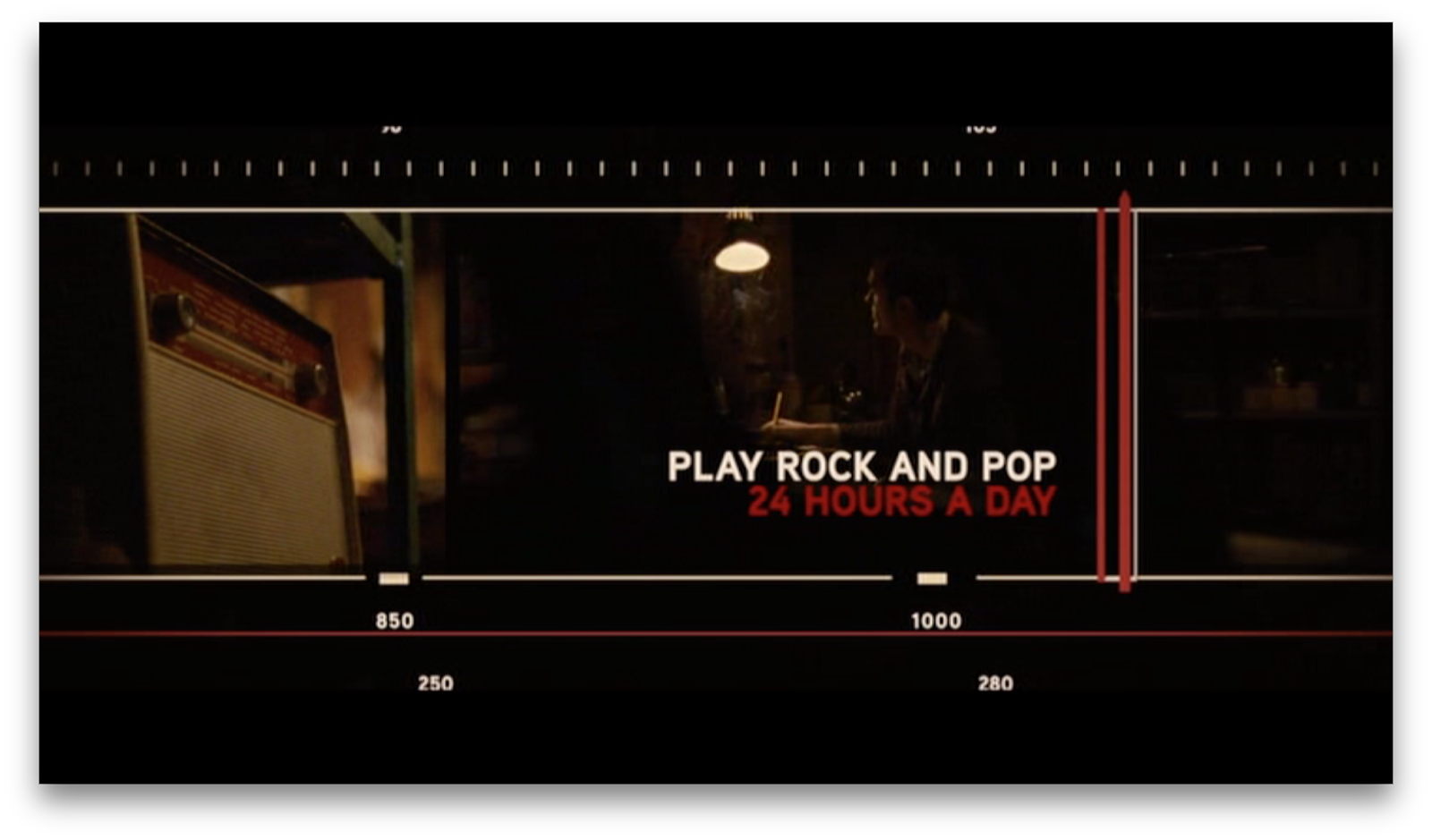
There are 14 titles although some of these titles are ones that tell a story. The animated graphic on screen is tuning a radio representing radio dial and the titles are in a strip going across the screen. Each title is positioned differently- this is to avoid dullness. Also the titles have more that one colour, white and red. Each title is transitioned with a wipe edit. This was to create verisimilitude as the film was set in 1966 and now to see a wipe edit being used. In the title "The Boat That Rocked" the words "boat" and "rocked" we're in upper case whereas the words "the" and "that's" we're in lower case and half the size. 

Duration
The opening sequence is 00:03:15 

Sound, Music 
On the working title company ident there is an audio bridge starts. The sound is diegetic because the it is coming out a radio. The music ends when the last title comes on before the 1st shot.

Shot Variety
At the start the shots are fairly short. A shot reverse shot, shot revesrse shot them a cut away show has been used.

Intertextuality + Genre Signifiers 

Narrative + Exposition 

Mise-en-scene: Props, Location, Lighting
The mise-en-scene is a montage with lots of different clips. It is switching between the radio station on the boat and lots of locations around Britain of people listening to the radio live.


The key props that can be spotted is the microphone in the radio station and the radios that the people around Britain are listening to.

Transitioning to the main film 
The opening of the film is separated from the main body of the film by the title which is conventional. The edited footage in the opening links to the audio nicely as he is waving his arms to the sound of the music.


Four Lions Opening Analysis

(Chris Morris, 2010)
Produced by Warp Films, (+ Film4; Wild Bunch, Optimum Releasing)
Budget: £2.5 million


Overall, the opening sequence is about 3mins20secs long, with two company idents and four titles. It seems that the lack of titles for this opening is done deliberately so that the audience will focus on the story and characters right away. The film seems to be trying for verisimilitude, as it doesn't start with a montage and non-diegetic sound, but with a long-shot of one of the main characters. There isn't much of a narrative enigma, but this works as it fits with the characters (who seem rather unintelligent) and are rather unsubtle.

The film opens with the company ident for Wild Bunch (10 seconds in length.) As "Wild Bunch" is a German Film Distribution Company, we understand this company ident to mean that they were the distributors for "Four Lions"


"Film4" is a production company, so this company ident (10 seconds in length) reveals to us that they produced "Four Lions".

Both company idents keep their original sound.


This is the first shot of the film. There are no titles - it simply cuts in with a static medium-long shot (that shifts ever so slightly) of one of the characters in the middle third. All the sound is diegetic. It can be denoted that the character looks middle-eastern, is wearing dark, khaki clothing, and a head band with what appears to be islamic writing on it: this exposition shows us that the character is islamic, and given that the audience is likely to have seen videos of terrorist propaganda on the news (intertextuality) we understand that this character is meant to be a terrorist. A narrative enigma is created briefly as an audience wonders what he is going to say and what's going to happen next. The lack of titles seems to have been done to create a strong sense of verisimilitude (as if this were really a terrorist demands video, as that wouldn't have titles.) 


In the next shot (cuts to a long shot - which is important as it increases the shot variety) the rest of the main characters are revealed, and it becomes clear to the audience that they are not actually a serious terrorist group, but just four Pakistani's from Sheffield, West Yorkshire (exposed through their accents.)  However, there is a slight narrative enigma as we (the audience) are left wondering what they're trying to achieve by being terrorists. We can denote that the room they are in is shabby and sparsely furnished, which has connotations of our main characters being lower-middle class. 
However, there is a jump-cut to a medium shot of Omar's (the protagonist's) family, but now the room in which they are in is a lot cleaner and nicer, a direct contrast to the place in which we first met Omar. This creates a binary opposition; the terrorist, and the family man. It must be denoted that his wife is a nurse, and that he has a young son; these two facts both make the audience more connected to Omar, despite his attempts to be a terrorist. All sound up until this point has been diegetic, but non-diegetic music begins to fade in (providing an audio bridge.)


This is the 1st title to appear in the film, however it doesn't appear until 3:01. The word "presents" shows us that Film4 produced this film. Non-diegetic music (which sounds middle eastern and quite serious) has begun to play by this point. This footage provides the transition (with the aid of an audio bridge) from the introduction to the main film, and also gives anchorage to help with the context (e.g. that it takes place within a city.)
This is the (2nd and) main title (the name) of the movie. It's written in sans-serif and is easy to read; fonts like this are commonly used in comedies and dramas ("Four Lions" being a combination of the two.) It's small, and in the lower middle third of the screen, however as the camera zooms in on the Mosque with fairy lights (center, middle third) we understand that this movie is to focus on Islam; the mosque is being used as anchorage. As we've seen the four Jihadi terrorists by this point, we understand the title "Four Lions" is a direct reference to them. 
Just as with the 1st and 2nd titles, the writing here is small, sans-serif style and pale coloured, meaning it is not eye-catching. Again it's also in the bottom two thirds, almost as if it was not meant to be seen (or at least focused on.) This title mentions the production company (Warp Films) and the director (Chris Morris - who is only mentioned once within the titles; this is unusual, as normally the director is mentioned twice.) The mise-en-scene here depicts an empty shopping center, which is revealed to be the place of employment of Omar. The use of the empty shopping center is to anchor the fact that Omar lives in the western world, which makes his involvement in a Jihadi terrorist group all the more confusing for the audience.

This is the final title for the opening, and it simply names two companies involved in the majority of distribution of this film; Wild Bunch and Optimum Releasing. Again, the writing is small and difficult to read, especially as it's placed in the bottom third. (The non-diegetic music ends here.)

*Each title lasts approximately 5 seconds (and they fade in/out,) with the overall title sequence stretching from 3:01 to 3:20.


(Main) Props List
  • Camera
  • Toy Rifle
  • Laptop

Location
  • Shabby living room
  • Modern kitchen
  • City at night
  • Empty shopping center\

Bridget Jones's Diary Opening Analysis

Genre: 
Rom-Com
Romantic Comedy...


The Players:
Richard Curtis- Wrote the original book of which the film was based upon, Andrew Davies adapted that to create the film.

The first few shots taken from Bridget Jones's Diary are the production companies involved in making of Bridget Jones's Diary.


'Working Title' are a major film company, and attract the biggest stars, typically American, and if British, white and southern, this is because, from a marketing point of view, this sells more copies, therefore, more income for Working Title, which is the primary focus of the company.
-4 company idents:
-Universal Studios // 20 seconds
-Studio Canal // 16 seconds
-Miramax Films // 14 seconds
-Working Title // 10 seconds
Altogether 60 seconds
The 1st Shot:


  • In BJD, the opening shot contains the main character, with a medium close up shot. Rarely do you see the main characters face immediately, however due to the nature of the film, it is logical with reference to the non-diegetic sound of her thoughts, therefore we can see who's voice it is, helping the viewer follow the plot. 
  • Female main character, this could suggest it relates to girls more than guys, potentially making it a romantic film, or 'chick flick'. Uses cross fade for transition between shots. The mise en scene has only a small level of importance, however, it is key in determining the time of year and what this could denote it is Christmas/winter due to the weather (snow).
  • The film opening lasts 11 minutes and 54 seconds.
  • The opening sequence begins at 60 seconds / 1 minute.

Titles
  • Main Title is in bold, and a larger font than the subtitles
  • San Serif.


  • Positioned left side of the screen.
  • They include names of directors and procures etc
  • Each last the same length of time and fade in and out
  • each are the same size apart from the main title
  • The size of the sub titles don't change, signifying each person has contrubted the same to the overall production and making of the film
  • The job of which each person named is smaller and thinner, whereas the name is a bigger font and in bold.
  • the colour stays the same throughout
  • there is no animation to the titles 
  •  


Subtitles before main title...
  • These subtitles come before the main title... 'Bridget Jones's Diary', the subtitles are a lot thinner in comparison, this could denote that every person involved in production adds up to something much bigger, 
  • Signified by the font // Serif font.
  • All positioned on the left and in the same font and size.
  • 19 subtitles in total before main title
  • Each title has a 9-10 second gap between each one and last for 4 seconds each
  • Overall the subtitles last 1 minute and 40 seconds after 1 minute of company idents.
Sound, Music:


  • The opening sequence has non diegetic and diegetic sound.
  • Non diegetic is in the opening shot, we hear 'Bridget Jones's' thoughts over watching her go to her mums for Christmas denoted by the heavy snow, which leads to verisimilitude.


Characters:
The opening scene follows the main character, and uses non diagetic speach from her, from this we get to know the character and can see things from her perspective. There is also binary oppositionbetween 'Bridget', and a 'divorced single man' who her mother tries unsuccessfully to set her up with to begin with.


Shot Variety:
The shot type varies throughout the opening sequence, including and establishing shot in the opening scene. Along with a close up which brings power to the scene.

Atonement opening analysis


(Joe Wright, 2007)
Produced by Working Title (+2); distribution: Universal
Budget:$30m
Box Office: $130m (world); $51m (USA), £11.5m


The titles in this opening include:
  • Universal (company idents)
  • Working title (company idents)
  • Universal pictures presents
  • In association with studio canal and relativity media
  • A working title production
  • Atonement       
The titles in this film are unconventionally short and there are only 6 which is strange. Usually there can be up to approximately 30 titles at the start of a movie. This however allows the user to get straight into the film. The title sequence includes 2 company dents including: universal (the distribution company) and working title which can be identified as the production company. The sequence then includes 4 titles which all follow the same format of a black background with white text which follows the conventional documentary style opening giving it a sense of importance. The universal ident lasts 20 seconds whereas the working title ident lasts 10 seconds. This creates the effect that universal is bigger and more important than working title. The opening title sequence (and idents) lasts exactly 52 seconds which again is unconventionally short in regards to film opening durations.

The title 'ATONEMENT' then appears as to be written by a type writer to signify the time period in which it was set achieving a sense of verisimilitude.

The transition into the main film sequence and into the 1st shot is a sudden frame switch which takes place at 53 seconds. This is an example of a cut shot as there is no smooth transition between the frames.

The opening of this movie includes a variety of things which can be connoted and detonated. For example at the start after the titles have played you can simply hear a type writer. This is an example of verisimilitude as it shows that the movie is set in the time of the typewriter, 1939 to be exact. The first shot is one of a big child's play house. This can be denoted to signify wealth and childhood. It also helps the setting of the first scene which is in the bedroom of a young girl. The setting of the whole opening of the movie is mainly in this one house. The camera then follows a long trail of child's toys which further signifies the fact of wealth and the abundance of non-essential play toys.

The sound of the type write keeps playing throughout the first couple of scenes. This is an example of diegetic audio which allows the reader to understand that there is actually a type writer present in the scene. the room in which the first scene is filmed is a big posh children bedroom which again signifies to the viewer the extent of the wealth that the people of the house own.

You quickly learn from the scene that the girl is writing a play which sets the story line going for the film. The girl in context to the whole film may be seen as an antagonist as she plays a part in a sinister role throughout the film. As the girl leaves the room the pace of the recurring type writer increases even though the girl has actually stopped using it. This is an example of non-diegetic audio. This increase in pace works with the fast pace of the girl almost running through the massive estate which is her home. 

The use of camera shots varies between shot reverse shot which aids the viewer in seeing the whole conversation which is involved in the shot reverse shot, and the use of other shots such as close ups which the 1st shot is. The 1st shot is somehow ironic in the sense that it is a close up shot of a doll's house representation of the house in which the film is set. This then leads to the medium over the shoulder shot which sets the scene and introduces the main character.

Harry Brown opening analysis


This is the opening scene to the social realist film Harry brown.

Director:

 Daniel Barber

Writer:

 Gary Young (screenplay) 

Stars:

 Michael Caine,  Emily Mortimer,  David Bradley

Storyline

In England, retired Royal Marine Harry Brown spends his lonely life between the hospital, where his beloved wife Kath is terminally ill, and playing chess with his only friend Leonard Attwell in the Barge pub owned by Sid Rourke. After the death of Kath, Len tells his grieving friend that the local gang is harassing him and he is carrying an old bayonet for self-defense; the widower suggests him to go to the police. When Len is beaten, then stabbed to death in an underground passage, Inspector Alice Frampton and her partner Sergeant Terry Hicock are sent to investigate. They pay Harry a visit but don't have good news; the police have not found any other evidence, other than the bayonet, in order to arrest the hoodlums. This mean that should the case go to trial the gang would claim self-defense. Harry Brown sees that justice will not be granted and decides to take matters into his own hands. (information attained from http://www.imdb.com/title/tt1289406/?ref_=nv_sr_1)
This film opening does not exactly follow the conventional style of film openings in the sense that it  includes 3 Company dents and 3 titles which, combined, last up to 40 seconds of the film opening. It is unconventional as after the first opening scene 11 more credits appear stating simply who starred in the movie. This section of credentials last approximately 40 seconds also. The titles used  are of a pure black background with white text on top. This gives it a documentary style look of the film which could possibly be connoted to mean that the film itself, even though is fictional, has elements of truth and possibly even illustrates some aspects of impoverished life amongst the worst council estates in England.

This movie can be closely followed with our movie in the sense that it is old Vs. young however in our story old and young come together. The style of this social realist film is much more action packed and could be classed as a thriller due to the gory and sinister nature of the film. This film focuses on the detrimental impact that street gangs have on their neighbouring society. This film can also be compared to 'The Guvanors' in which there is a clash between younger and older street gangs in a rough estate situated in London.
These films have therefore influenced me to proceed with my social realistic short film with a slight twist on the fact that supports the idea of social mobility through two very different men saving each others life in very different ways.

Wednesday, 7 October 2015

Film openings analysis

Whilst analysing and researching the generic conventions of film openings, I have come to a conclusion of the main aspects I should be looking for.

For example:
- The opening shot - semiotics (signify genre). The camera shot used, usually an establishing shot.
- The setting of the opening scene - denotation of it e.g. location(s)
- The date of the setting - verisimilitude
- The absence of revealing too much
- Genre signifiers
- Narrative enigma
- Audio (Diagetic or Non-Diagetic) - Typically Non-Diagetic such as music
- Exposition - what i shown on screen and what isn't
- Use of camera shots e.g. Cross fade
- Protagonist or antagonist used to help the viewer identify the important characters.
- Dependant on the movie, male gaze might be used
- Signifiers
- The titles which appear on screen e.g credits or company idents and if the same company or person                        receives multiple mentions, why do they?
- Camera angles e.g. Establishing shot, Close up etc.
- The length of the opening scene
- Characters (Age, gender, nationality etc.)
- Editing
- Costume - can signify the genre and helps the achievement of verisimilitude
- Intertextuality - The meaning of the text is linked to the meaning(s) of other text(s) such as current affairs and culture.
- The use of colours to help the viewer understand the atmosphere of the scene.

How to reach excellence

Coursework task

Your coursework brief is to create the opening 2 mins of a new feature film including titles. Before embarking on any production in Media Studies, you must always thoroughly research and analyse the prevailing codes and conventions (not 'rules') of a given format, then look more closely at those of a specific (sub-)genre once you've settled on a firm production idea.

TASK 1: [post] The role of researching conventions in our coursework
Using either your printed copy or an online version, look through the assessment criteria for all three marked sections of your coursework and note in this post any and all elements of this that are linked to researching the conventions of film openings (and film/genre conventions more broadly). Include any relevant Evaluation questions in your list.

TASK 2: [post] What I should look for when blogging on film openings
We will discuss this in a class, after which you should consolidate your list of things to consider by carefully reading this post.

Ask if unclear about any terms.

TASK 3: [multiple posts] Titles, 1st shot, length of opening
You will each view and analyse 2 film openings, feeding individual findings, including typed detail and plentiful screenshots, into the following posts:

TITLES EG2 [Film Title] - as we did with Pretty in Pink, note every title. Include several screenshots to demonstrate any common features and variations in these (size, colour, position, font, case, animation/transition/FX, diegetic integration, single/multiple credits, any name credited twice [hint: auteur]). Note clearly the timings of these: do they appear continually; from the very start or later (when?); continue right to the end (maybe beyond?) the opening; are the gaps between them equal in timing or variable (is there any pattern to this). Note the specific language used for company names - and specific whether these companies or production or distribution companies (look them up - and include relevant hyperlinks as part of your post's presentation!). 

Discuss the main font used: is it serif or sans-serif; clearly linked to (connoting) a genre - is this the expected connotation or signifying, maybe even juxtaposing, a different genre; what are your general thoughts on its semiotics? Is the main title font any different (always screenshot this)?

OPENING SHOT EG3 [Film Title] - we've discussed the semiotics of TisEng's opening shot in detail, now do the same for this. Don't twist your analysis to fit the genre, it doesn't always match the genre so neatly. Consider exposition, narrative enigma, (non-)diegetic sound, anchorage/polysemy - sound is relevant as well as mise-en-scene. Is the camera static or moving (does the shot/framing change?). What does this lead into? Looking ahead, you could apply Todorov's narrative model (equilibrium).

OPENING LENGTH + NARRATIVE [Film Title] - how long is the opening sequence? How is the ending of this denoted? What exposition has been provided (type a very brief bullet list for this, not a paragraph): have the pro/antagonists been signified (can you detail how with reference to framing and editing in particular?); Proppian archetypes; binary oppositions; the location; time/era; genre (maybe hybrid?); equilibrium, dis-equilibrium (central conflict). To what extent has narrative enigma been utilised? Can you spot any intertextuality?

http://asmediafilmopening.blogspot.co.uk